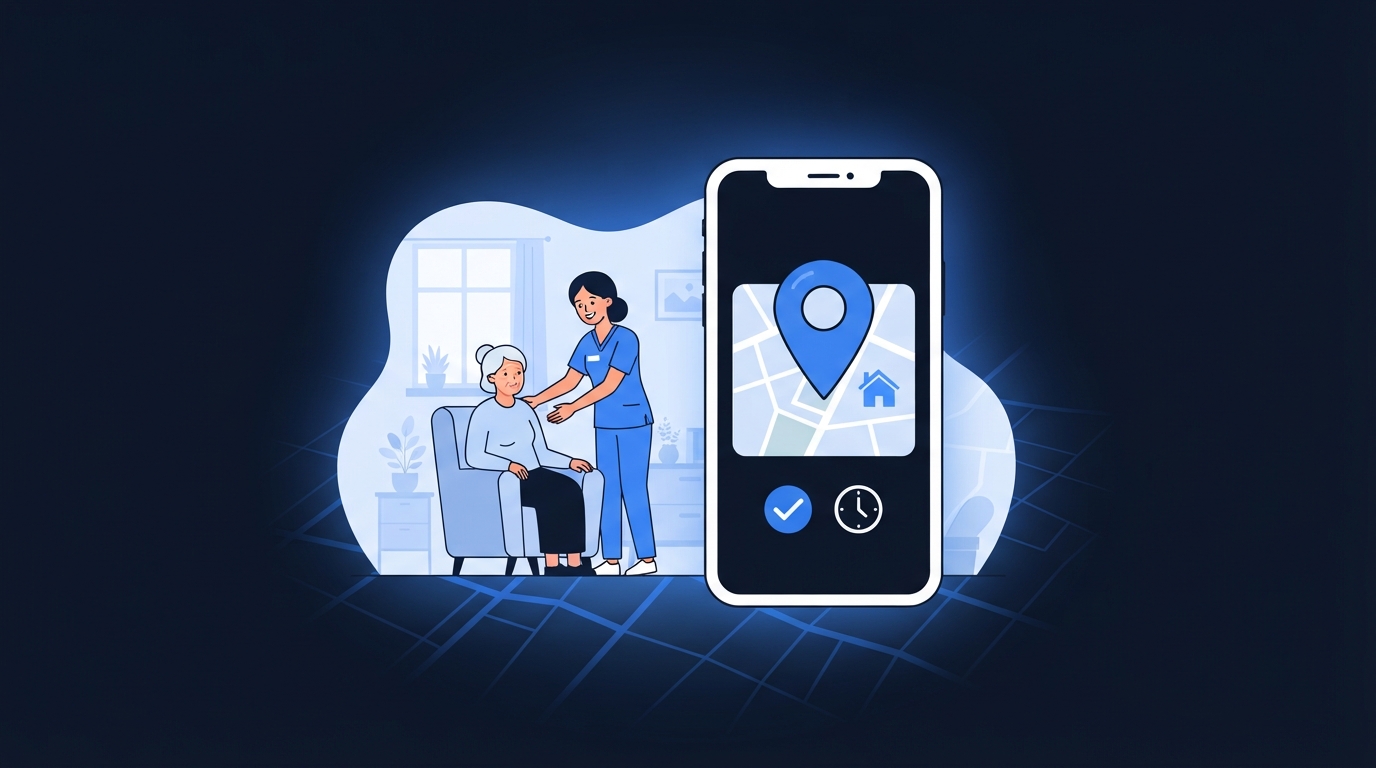
Electronic Visit Verification isn’t optional anymore. Since the 21st Century Cures Act mandated EVV for Medicaid-funded personal care services, every state has rolled out its own aggregator, its own rules, and its own tolerance for error. For agencies still relying on paper timesheets or a scheduling app bolted onto a spreadsheet, EVV has become the single biggest source of denied claims and lost revenue.
This guide walks through what EVV actually requires, where agencies most commonly fail compliance, and what a 98%+ compliance rate actually looks like in practice.
What EVV actually verifies
EVV systems are required to capture six data points for every visit: the type of service performed, the individual receiving the service, the date of service, the location of service delivery, the individual providing the service, and the time the service begins and ends. Missing any one of these fields is enough for a state aggregator to flag or reject a claim.
The most common compliance failures
- Caregivers forgetting to clock out, leaving a visit open indefinitely
- GPS location mismatches caused by manual entry instead of live capture
- Visit data submitted to the wrong state aggregator format
- Missing or incorrect service codes tied to the wrong payer
- Late submission windows — most states require same-day or next-day submission
Individually, each of these looks like a small clerical slip. At scale, across dozens of caregivers and hundreds of visits a week, they compound into thousands of dollars in denied Medicaid claims every month.
What good EVV compliance looks like
Agencies running above 98% compliance share a few things in common. First, clock-in and clock-out is GPS-verified automatically at the moment of the visit — not entered manually after the fact. Second, exceptions are flagged in real time, not discovered during a monthly billing reconciliation. Third, visit data flows directly from the EVV capture into the billing system, so there’s no re-keying and no second point of failure.
Telescope’s built-in EVV syncs directly with major state aggregators, captures GPS at clock-in and clock-out, and flags exceptions before they ever reach a claim. Agencies on the platform average a 98.7% compliance rate — well above the industry norm.
A pre-audit checklist
- Confirm every open visit from the last 30 days has been closed out
- Review flagged exceptions weekly, not monthly
- Verify your aggregator sync logs show successful daily transmission
- Spot-check GPS coordinates against client addresses on file
- Confirm caregiver credentials tied to each visit are current and unexpired
EVV compliance isn’t a one-time setup — it’s an operational habit. The agencies that treat it as a daily discipline, backed by software that automates the capture, are the ones that stop losing revenue to denied claims.